
Review Tales
Trusted Reviews and Author Features Since 2016
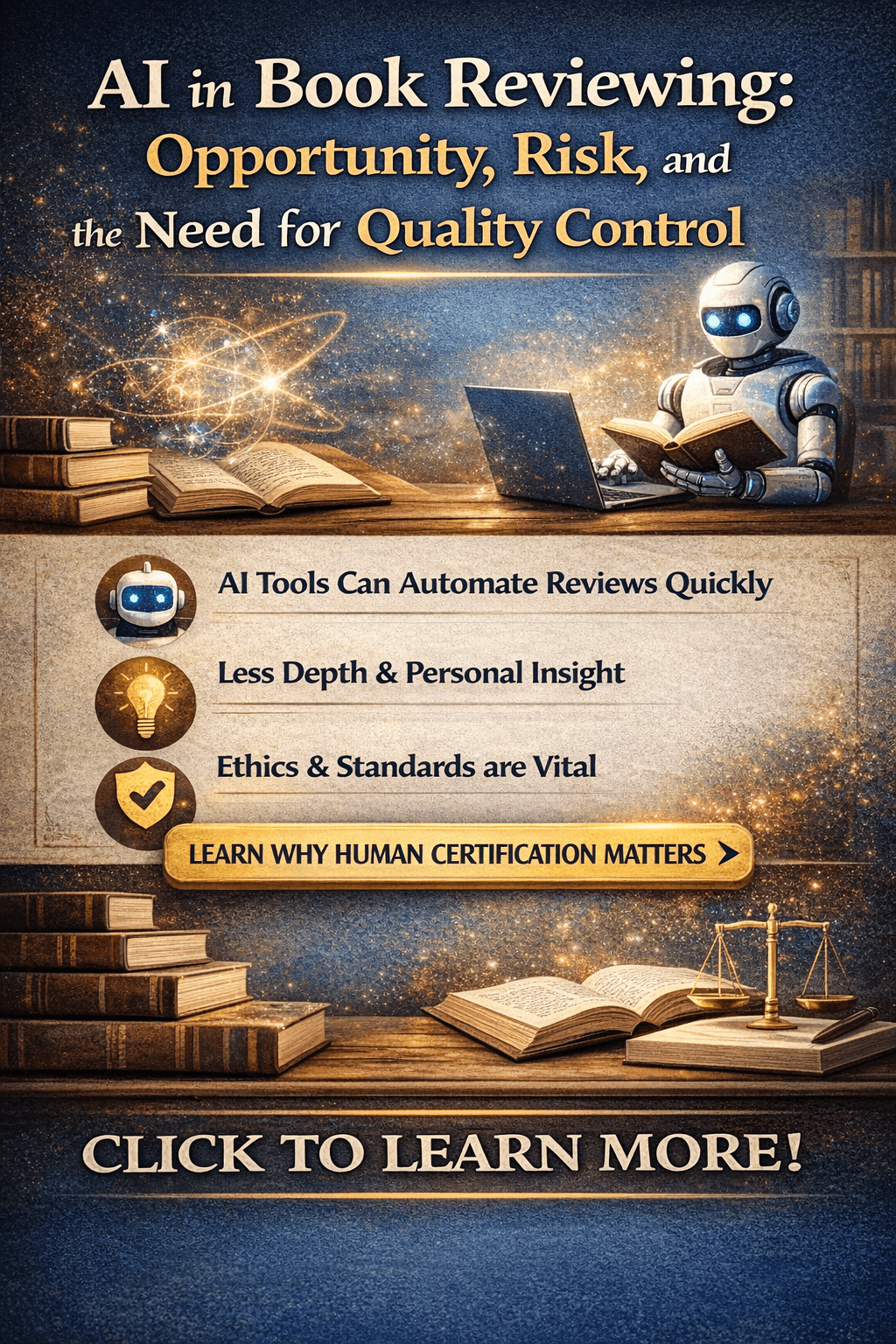
AI in Book Reviewing: Opportunity, Risk, and the Need for Quality Control
Introduction
Artificial intelligence is transforming content creation across industries.
From automated writing tools to AI-assisted editing and instant summarization, technology is reshaping how information is produced, analyzed, and distributed.
Book reviewing is not excluded from this shift.
Today, AI tools can generate structured review drafts in seconds.
This creates opportunity.
But it also introduces risk.
As technology evolves, professional standards and quality control become more important than ever.
The Rise of AI-Generated Reviews
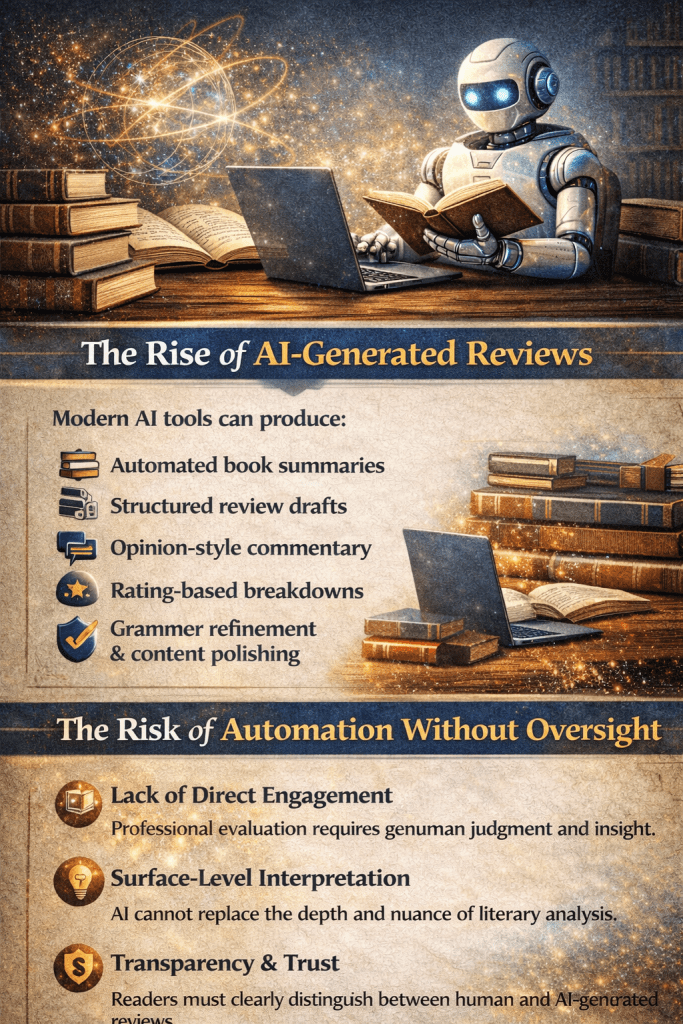
Modern AI tools can now produce:
• Automated book summaries
• Structured review drafts
• Opinion-style commentary
• Rating-based breakdowns
• Grammar refinement and stylistic polishing
These systems dramatically increase efficiency and reduce the time required to produce written content.
For professional reviewers, AI can function as a productivity assistant.
However, efficiency does not automatically equal credibility.
A review generated entirely by AI may appear polished and structured, yet lack genuine evaluation, critical reasoning, and authentic engagement with the book itself.
Professional reviewing requires judgment, not just formatting.
The Risk of Automation Without Oversight
1. Lack of Direct Engagement
A professional review should reflect meaningful interaction with the text.
Without actual reading, reflection, and contextual understanding, content becomes mechanical rather than analytical.
An authentic evaluation cannot be automated.
2. Surface Level Interpretation
AI systems recognize patterns and summarize information.
They do not truly interpret:
• Emotional nuance
• Literary symbolism
• Authorial intention
• Cultural context
• Subtle thematic layers
These elements require a trained human perspective and literary awareness.
3. Transparency and Trust
When readers cannot clearly distinguish between:
• Human-written reviews
• AI-assisted reviews
• Fully AI-generated reviews
Trust becomes fragile.
Transparency is essential.
Professional standards must define how AI usage is disclosed, regulated, and ethically integrated.
How Professional Standards Protect Integrity
Certification and structured training create clarity around AI integration.
A professional framework should define:
• When AI tools are appropriate
• Acceptable levels of AI assistance
• Required human oversight
• Disclosure expectations
• Ethical boundaries
The goal is not to reject technology.
The goal is to regulate its responsible use.
Standards allow innovation while protecting authenticity.
AI as a Tool, Not a Replacement
Artificial intelligence should support professional reviewers, not replace them.
AI can assist with:
• Structuring ideas
• Improving clarity
• Enhancing grammar
• Identifying recurring themes
• Drafting preliminary versions
But interpretation, evaluation, and accountability must remain human responsibilities.
Certification ensures reviewers understand this distinction and apply technology responsibly.
The Future of Quality Control in Digital Publishing
As AI becomes more advanced, questions of authenticity will increase.
Organizations that establish clear quality control systems will gain credibility.
Professional certification can:
• Define ethical AI integration
• Establish transparency benchmarks
• Create measurable performance standards
• Protect industry integrity
In a digital publishing environment, structure builds trust.
Strengthening Professional Practice
Review Tales is developing standards that integrate technological awareness with professional accountability.
If you want to stay ahead in the evolving publishing landscape, understanding how AI interacts with professional review practice is essential.
Adaptation drives growth.
Standards protect credibility.
📥 Free Resource
Download the Professional Book Reviewer Standards and Framework Checklist
Includes:
• Ethical AI usage guidelines
• Quality control principles
• Professional review structure
• Certification framework overview
About The Author
Jeyran Main
Founder — Review Tales
Certification Framework Developer
Developer of structured professional standards for book reviewers and creator of the Certification Framework Initiative.
Discover more from Review Tales
Subscribe to get the latest posts sent to your email.


 Review Tales