
Review Tales
Trusted Reviews and Author Features Since 2016
Interview with Stephen C. Pollock

When did you first realize you wanted to be a writer?
I began writing independently of schoolwork when I was nine. On the one hand, I scribbled rhyming poems in pencil on the cardboard that came with my father’s laundered shirts. On the other hand, I wrote essays on the structure and functions of the human body. By the end of that year, I had drafted enough material for an illustrated manuscript on human anatomy and physiology. This of course was never published, but it did anticipate my future career as a physician.
How do you schedule your life when you’re writing?
I’ve never had the ability to establish a set schedule for writing, so crafting poems tends to be sporadic and unpredictable. That said, once an impulse or idea for a poem materializes, my approach becomes focused and intense. I often begin as I did in childhood, with pencil and paper. After sketching out a preliminary concept or drafting a few auspicious words or phrases or stanzas, I transition to composing in Word on a laptop. The key for me is to occupy a mental space where words, sounds, rhythms, and metaphorical possibilities freely and continuously enter the mind, while at the same time, applying critical filters to eliminate the 99.9% of options that lack usefulness or merit. When fully engaged and maximally productive, my efforts typically result in four new lines of poetry per day (derived from perhaps a dozen pages of notes and drafts).
What would you say is your most interesting writing quirk?
Editing, which I would describe as merciless. I’ve learned from experience that a satisfying first draft almost always begins to exhibit its flaws after sufficient time has elapsed to afford an objective assessment. For example, the eight-line poem “(eclipse)” underwent nineteen revisions over nineteen years.
How did you get your book published?
I was fortunate to have had a prior professional relationship with Maggie Lynch, the founder and manager of Windtree Press. After Maggie read the manuscript for Exits, she invited me to become a Windtree Press author.
Where did you get your information or ideas for your book?
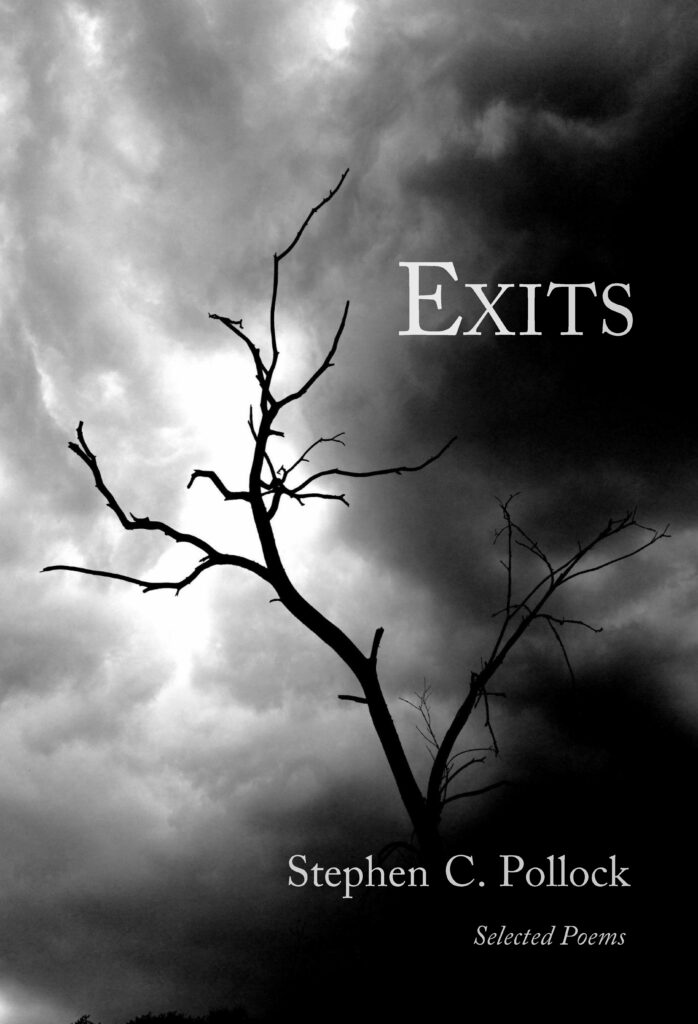
To answer that question, it’s important to point out that the overall theme of the book is mortality — disease and decline, death and remembrance.
I think that this focus on the finite nature of our biological selves derived from three sources. First, I was raised without any religious training, so from a very young age, I was left on my own to ponder the enormity of the universe, time and eternity, and the meaning of existence. Second, as a physician and neuro-ophthalmologist, I’ve cared for numerous patients with serious and/or life-threatening diseases. And third, since 1999, I’ve had to deal with the spinal cord variant of multiple sclerosis and the ramifications of that disease.
What do you like to do when you’re not writing?
- Exercise
- Eat dinner with my wife while watching murder mysteries, particularly those produced in the U.K., France, Finland and New Zealand.
What was one of the most surprising things you learned in creating your book?
The amount of time required to: select the poems from my existing oeuvre; determine the order of poems; select the artwork; design the front and back covers; draft the “front material” (title page, copyright page, table of contents, and preface); select font style and sizes; and format the book’s interior. Getting to the final product involved twenty print runs over a twelve month period.
As a child, what did you want to do when you grew up?
Although my mother was an artist who introduced me to modern art before I could read, I also had an abiding interest in the human body, an interest fed by parents who bought me quite a few books on the subject. I was more or less programmed to be a physician from an early age.
How do you process and deal with negative book reviews?
I’ll probably be struck down for hubris or, at a minimum, put a hex on the whole review process, but up to this point, Exits has received exceptional trade reviews (a.k.a. professional or editorial reviews). Excerpts can be viewed on the book’s website, exitspoetry.net.

Discover more from Review Tales
Subscribe to get the latest posts sent to your email.
One Comment on “Interview with Stephen C. Pollock”
Leave a Reply


Pingback: Exits by Stephen C. Pollock (July-Aug. 2023) |