Review Tales
Trusted Reviews and Author Features Since 2016
Interview of David E. Goldberg

- Why did you write A Field Manual for a Whole New Education: Rebooting Higher Education for Human Connection and Insight in a Digital World?
Higher education should be an exciting time of growth, learning, and engagement, but more and more students are finding higher education in universities and colleges a dull and disengaging turnoff. In larger numbers, they are turning to trades apprenticeships, coding schools and certificate programs, and other learning-by-doing experiences. To reverse this situation, higher education must change, but existing change processes are inadequate for the task. Curriculum committees and administrators change-by-fiat tweak the status quo in ways that fall short of the needed change. The field manual gives practical step-by-step processes, skills, and mindsets to make the needed deep change.
- When did you first realize that higher education needed big changes like those you’ve suggested.
In 1992, I was on assignment as an assistant dean in the College of Engineering at the University of Illinois (UIUC). I thought I would get a glimpse of first-rate minds making important policy decisions for the future of higher ed. Instead, I found me-too thinking that went along with the conventional wisdom. I wrote an article for the Journal of Engineering Education called Change in Engineering Education: One Myth, Two Scenarios, and Three Foci. The article won a best paper award in 1996, but it was ignored at my school for 11 years when, in 2007, I started the Illinois Foundry for Innovation in Engineering Education or iFoundry and partnered with Olin College (olin.edu). That experience led to writing A Whole New Engineer: The Coming Revolution in Engineering Education. The field manual generalizes the experiences of that book to all of higher education.
- What are the key lessons of the Field Manual for those who are trying to make change?
The big lesson is that change isn’t what you think. The fundamental flaw of education change is to think that if you change curriculum and pedagogy, that education will change. The problem is that deep change depends on both the mood and the culture change. The field manual helps change agents make a deep change by (1) shifting key skills and mindsets, (2) introducing a practical set of sprints and spirits that create deep change, (3) training change agents in curious listening to that encompasses NLQ = noticing, listening, and questioning, (4) emphasizing the emotional shift in mood that accompanies deep change, and (5) exploring the ways that artificial intelligence, robotics, apps, and machine learning (what the book calls the digital gaggle) are inferior to human processes of innovation.
- When did you first realize you wanted to be a writer?
In April 1980, I was at the British Hydromechanics Research Association on Pressure Surges meeting in Canterbury, England, representing my company (Stoner Associates, Inc.) and my master’s research advisor, Ben Wylie, walked in the room and it was like the parting of the Red Sea in Exodus. I wondered why for a brief moment, but then realized it was because he wrote the book on pressure surges (Fluid Transients). I knew that night that I would someday write a book. (I also knew that night I would marry my girlfriend and go back and get a PhD, but those are different questions. It was a big night, however.)
- How did you get your book published, and how long have you been a writer?
I published it myself in my consulting, coaching, and training firm, ThreeJoy Associates (threejoy.com). I have been a writer since 1976 when I wrote my first paper during my master’s degree in civil engineering. I wrote my first book in 1989 with Addision-Wesley. See here: https://www.amazon.com/Genetic-Algorithms-Optimization-Machine-Learning/dp/0201157675. Big publishers don’t do much to market books, so I like the control of self-publication, and Amazon KDP does a nice job of putting books in print and Kindle. I have published other titles, including Life Skills and Leadership for Engineers, The Design of Innovation, The Entrepreneurial Engineer, and as an academic, I wrote or co-wrote hundreds of papers. You can browse my Google Scholar listing here: https://scholar.google.com/citations?user=BUzKxsoAAAAJ&hl=en.
- How do you manage your writing, and what are your most important writing habits?
My body’s feelings tell me when I am ready to write. When I’m ready, it just works, and I try to schedule other things around my muse being in the groove. I eschew detailed outlines and prefer Peter Elbow’s approach to what I call quickplanning. This allows freewriting followed by bouts of editing. Separating editing and creation (a particularly important co-contrary in writing) is really important for me to be a productive writer and make rapid progress.
- What do you like to do when you’re not writing?
I take walks in nature with my wife of 42 years, play jazz guitar, and like to travel internationally by plane or ship. I have two grown sons, and I also like to stay connected with them and travel to hang out with them.
- As a child, what did you want to do when you grew up?
I wanted to be an engineer (like my dad), but I took a test in college that said I was more like a humanist or social scientist. As an engineer, the humanist and social scientist in me has been given a full venue in my current work as a change agent and an executive coach.
- How do you process and deal with negative book reviews?
I follow Miguel Ruiz’s advice in The 4 Agreements and try to take nothing personally. People who react badly to my work understand it differently than I do. They are entitled to that view, and sometimes after I’ve returned to the centre, I find nuggets in the criticism that may be valuable to pursue.
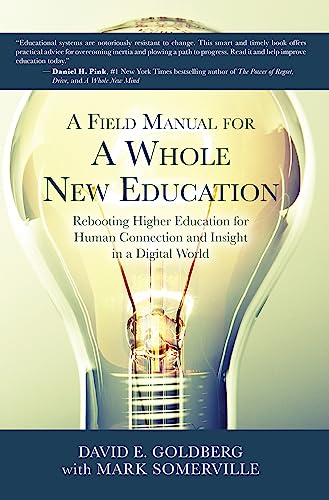
Book Title: A Field Manual for a Whole New Education: Rebooting Higher Education for Human Connection and Insight in a Digital World
Author Name: David E. Goldberg (with Mark Somerville as a contributor)
Pub Date: June 2023
ISBN: 978-0986080050
Book Category/Genre: Higher Education
Page Count: 208
Publisher: ThreeJoy
Author Bio:
DAVID E. GOLDBERG (Dave) is an artificial intelligence pioneer, engineer, entrepreneur, educator, and leadership coach (Georgetown). Author of the widely cited Genetic Algorithms in Search, Optimization, and Machine Learning (Addison-Wesley, 1989) and co-founder of ShareThis.com, in 2010, he resigned his tenure and professorship at the University of Illinois to work full time for the improvement of higher education. Dave now gives motivational workshops and talks, consults with educational institutions around the globe, and coaches individual educators and academic leaders to bring about timely, effective, and wholehearted academic change.
Book Description: The field manual explores both the “what” and the “how” to overcome some of the crises facing higher education—from the enrollment cliff of the dearth of students to the coming of the digital gaggle (generative AI, machine learning, robotics, and Apps). Step by step, the field manual develops the mindset and practices that successfully lead to crisis-overcoming culture and curriculum. Based on work at dozens of schools on 6 continents, the field manual highlights a series of shifts, sprints, spirits, and implementation keys that help administrators and key faculty and stakeholders become wizards of substantive change.
Discover more from Review Tales
Subscribe to get the latest posts sent to your email.


 Review Tales