
Review Tales
Trusted Reviews and Author Features Since 2016
The Impetus of GRAPHIC NATURE by Daniel Damiano

After my first novel was published, there was a certain degree of satisfaction in both having completed a pretty sizable work and also being able to share it with the general public. However, upon completing it, I did not assume I’d have another idea with which to create a second novel with any expedience. Perhaps I was even content with having written a sole novel, having spent the majority of my career as a Playwright and Actor. But within a few months, I realized that an older play of mine would actually lend itself nicely to the novel form. The play and the novel it would soon become is called Graphic Nature.
Initially, I loved the fact that the premise and setting would be so radically different from my first novel, The Woman in the Sun Hat, which was a contemporary story focusing on a Long Island wife, mother, and literature teacher whose life is suddenly changed by the arrest of her dermatologist husband. By contrast, Graphic Nature is set in 1913 France and focuses on Edmond de Capitiour, Chief Executioner, who is content with a relatively solitary life aided by his own introverted nature. However, his persona is tested by a developing attraction to a young patisserie clerk in Versailles – an attraction that becomes further challenged by an unwanted notoriety.
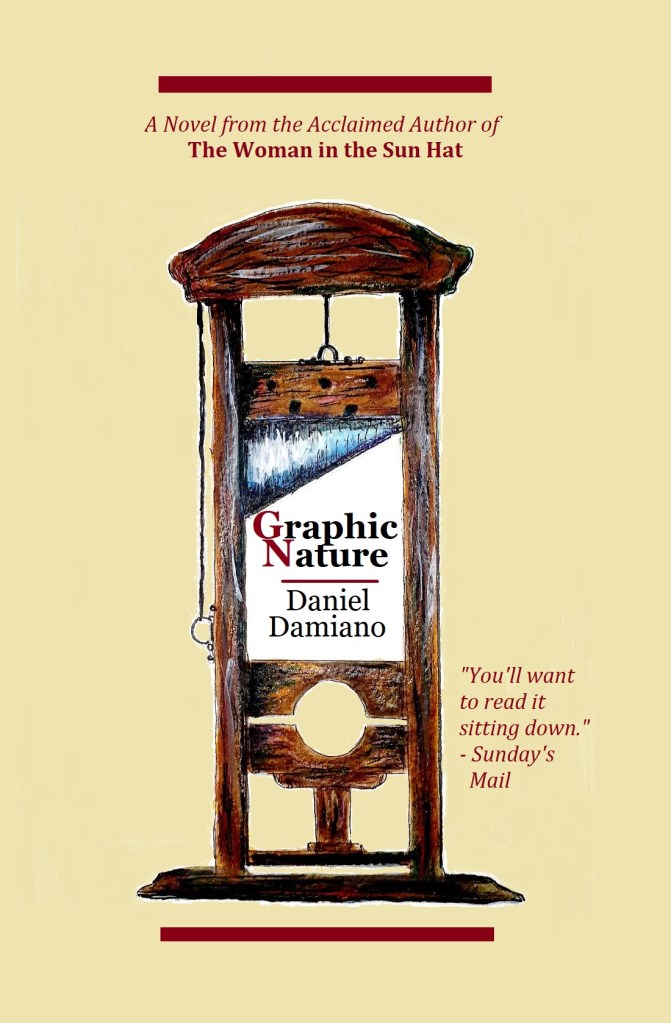
What was particularly interesting to explore with Graphic Nature, both as a play and even more as a novel, was creating a character-study while infusing it with romance, dark humor, gothic and existential elements, along with modern parallels to society’s morbid fascinations.
In fact, Graphic Nature’s roots were inspired by the very real Chief Executioner during the same period in France, who did become a sort of celebrity among citizens who attended the beheadings that he administered. While that real person actually was married and had children, what becomes the heart of Graphic Nature is Edmond’s desire, being a middle-aged bachelor, for more emotional fulfillment despite his cynicism and religious skepticism that his profession has only engrained in him.
What has been a particular joy to experience from readers is how they identify with Edmond’s quest for self, regardless of his unusual profession. In the end, I think readers can simply see him as a human being with struggles and questions that are identifiable to many of us.
Click here to feature your book in the Review Tales Magazine.
Discover more from Review Tales
Subscribe to get the latest posts sent to your email.


 Review Tales