
Review Tales
Trusted Reviews and Author Features Since 2016
The Drau River Flows to Siberia: The Victims of Victory by Marina Osipova (Book Review #2013)
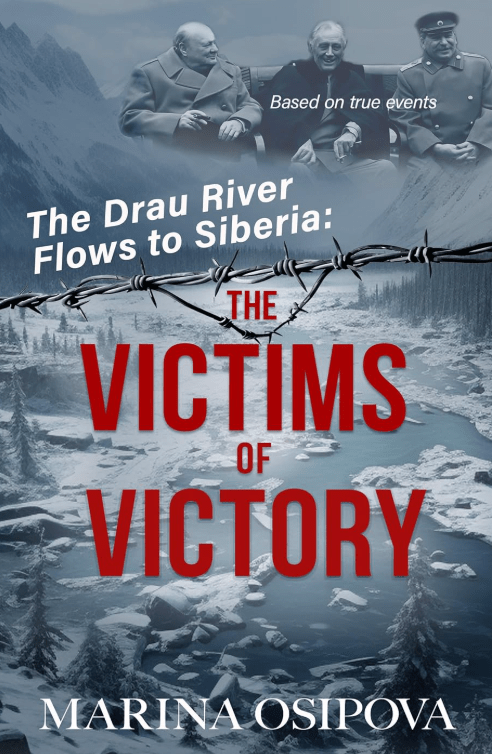
The Drau River Flows to Siberia: The Victims of Victory by Marina Osipova is a powerful and evocative historical novel that delves into the personal and collective tragedies wrought by war, ideology, and the brutal political landscape of post-World War II Europe. Set against the backdrop of the Yalta Conference of 1945, where the Big Three—Roosevelt, Churchill, and Stalin—agreed on the fate of Europe, the novel offers a deeply personal story of survival, loss, and the unshakable scars of war.
The narrative weaves together the lives of two central characters: Anna, a sixteen-year-old girl caught in the turmoil of the war, and Zakhary, a young man born into an émigré Cossack family in Berlin. Their paths intersect in unexpected and painful ways, as both are forced to endure the horrors of conflict and the harsh aftermath. Anna’s dream of becoming an operetta actress is shattered as she is thrust into the forced labor camps of Nazi Germany, while Zakhary, initially indifferent to the war, is swept into the conflict by his family’s anti-Bolshevik cause.

Through the eyes of Anna and Zakhary, Osipova paints a haunting portrait of the human cost of war. Anna’s story is one of survival and resilience, as she is auctioned off as a slave laborer, enduring unimaginable hardships in Germany and later in the Soviet Union. Zakhary’s journey is equally painful, as his desire for a simple life is replaced by a relentless series of events that drag him into the heart of the war and its aftermath. Their lives are forever marked by the war, as they both struggle with guilt, trauma, and the burden of their actions.
The novel’s exploration of the Cossack diaspora and the complex relationships between the Soviet Union, Nazi Germany, and the post-war world adds depth to the historical context. Anna and Zakhary’s personal stories mirror the larger political struggles of the time, particularly the tragic fate of the Cossacks who were caught between the retreating German forces and the advancing Soviet Army. The event known as Lienz—the forced repatriation of Cossacks and their families to the Soviet Union—serves as a pivotal moment in their lives, marking the beginning of their suffering in the unforgiving Siberian landscape.
Osipova’s writing is lyrical and poignant, capturing both the vastness and the isolation of the Siberian wilderness, which becomes a character in itself. The bleakness of the setting is contrasted with the characters’ determination to survive and rebuild their lives despite the overwhelming weight of their pasts. The book also examines themes of identity, loyalty, and the painful process of reconciliation with oneself and with history.
The connection between Anna and Zakhary, brought together by fate in 1955, serves as a central thread throughout the novel. Their shared trauma and the way their lives become intertwined is a testament to the idea that even in the most desolate of circumstances, there can be the possibility of redemption, understanding, and hope. As they struggle to build a future in a Soviet state that remains tightly closed behind the Iron Curtain, the novel raises important questions about the price of survival and the possibility of healing.
The Drau River Flows to Siberia is a deeply moving and thought-provoking novel that will resonate with readers who are interested in historical fiction that examines the human cost of war and the long-lasting effects of political and social upheaval. Osipova masterfully blends personal stories with historical events, creating a narrative that is both heart-wrenching and hopeful, offering a window into the lives of individuals who endured the horrors of war and its aftermath.
Written by Jeyran Main
Click here to feature your book in the Review Tales Magazine.
Discover more from Review Tales
Subscribe to get the latest posts sent to your email.
3 Comments on “The Drau River Flows to Siberia: The Victims of Victory by Marina Osipova (Book Review #2013)”
Leave a reply to Jeyran Main Cancel reply


 Review Tales
Thanks dear god
LikeLiked by 2 people
This review is exceptional. This sweeping adventure story certainly could not be imagined well by us in the West. Anyone caught up in both dragnets of opposing WWII military dictatorships, through no fault of their own other than being in the wrong place with the wrong ethnicity, should come out as terribly scarred persons. Yet this story tells of those same persons reconnecting their lives, even in the middle of new politics, continued prejudices.
“Cossack diaspora” is a great phrase, and well names what happened to these unfortunate people, as well as probably hundreds of other sub-ethnicities with the bad luck of living in the Soviet Union, with or without Joseph Stalin. Well done.
LikeLiked by 1 person
Thank you for commenting! I appreciate your feedback.
LikeLike