
Review Tales
Trusted Reviews and Author Features Since 2016
An Interview with for Suzanne Sunshower
1- When did you first realize you wanted to be a writer?
As a child I loved to read and write, and received ongoing encouragement from my Dad to do both. When I was six, he hired me to help him clip research articles for his weekly editorial column. A fantastic job, it helped develop my love for periodicals and journalism. At seven, he gave me his old typewriter so I could tap out ideas for my own stories. Then he gave me books to read about writing rules and grammar, and told me that I wouldn’t know if I really wanted to be a writer until I saw my name in print. I published a couple things before my teen years and he was right, I loved seeing my name in print. By 21, I was a serious freelance writer sending out story pitches, essays and poems. Soon, submitting writing for publication became solely about finding a caring home for it – not about seeing my name.
2- How do you schedule your life when you’re writing?
First of all, I always carry notebooks and pens. Writing tools abound in both my car and household, in case I get a bright idea or wish to savor a fine line. For half my adult life I chose to live as a freelance writer and artist, which for me meant working and living alone. Nothing else came first. Later, I took part-time or temporary positions, not just to get out of the house but to get out of my own head. At that time, my writing ideas flowed better when I got out among other people and experienced being in a ‘regular’ kind of life. Particularly when writing journalism, since you can’t engage folks on the page if you are not engaged with what’s going on in the world.
These days, I prefer to write during weekday business hours, when not at my part-time job; and I make art or build things for my wild homestead on the weekends.
3- What would you say is your interesting writing quirk?
I discovered fairly early that I preferred writing fresh drafts during the early daylight, usually with my typewriter on a table by a window. Yet, I didn’t mind editing (or rewriting) at other times of the day or at night. These days, I still prefer writing during weekdays while looking out at the trees from my window – whether it’s a fresh draft or a re-write.
4- How did you get your book published?
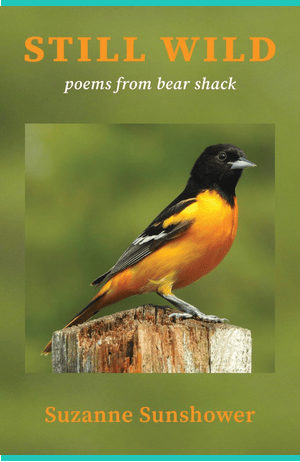
I stay aware of various publishing opportunities throughout the year. As I finish new pieces, or decide old ones are finally ready to make their way into the world, I usually submit them for consideration for publication in journals or anthologies. Upon finishing the full manuscript of “Still
Wild” by deadline, I submitted it for consideration to be published as part of the Modern History Press – Yooper Poetry book series. I was acting on the urging of an editor who had encouraged me to expand on some poems he had previously read during the submission period for an anthology.
Happily, I took his advice and my expanded version was accepted for that Yooper Poetry series.
5- Where did you get your information or idea for your book?
I knew I would write about my adventure of moving into a camper in the Upper Michigan woods and living semi off-grid with my new big puppy dog. But I thought it would result in a simple chapbook that I’d print off and send to friends, while perhaps publishing a few poems on the side. However, once I was encouraged by an anthology editor to expand my chapbook idea into a full manuscript, I was able to broaden the scope of issues that I wished to visit in my poems. For instance, a longer manuscript meant I was able to more fully acknowledge the grief that led to my move into the isolating woods. It also allowed for concerns about my advancing age to bubble up as an undercurrent, while still leaving room to forgive certain past grievances (via poems) by the book’s end.
6- What do you like to do when you’re not writing?
I hang out at the library! I am a fan of the Arts; so I attend classes, meetings, as well as lectures and local events put on by writers, artists, and academics. Seeing as I am currently living wild in the woods, I obviously like being outdoors and enjoying the local trees and water. Also, I love building things from what I have on hand or can find around my property. Such as, converting homemade bookshelves into bed frames and a dog house; or, creating a mailbox stand from young trees. Back when I lived in a major city, I acted in community theater.
7- What was one of the most surprising things you learned in creating your book?
I learned that I had more to say, and that I was done after I’d said it. By the time the book deadline came around, I had spent about three years living in the wild while writing about my submersion. Wrapping up the manuscript at that time, I felt I had fully shared what I wanted to within the expanded pages and that readers would feel invited along with me on my woodsy adventure.
8- Is there anything you would like to confess about as an author?
It’s not much of a confession, but I feel fulfilled when others experience joy (or strength or growth) through reading something I’ve written. It’s fabulous when others can relate to what I write, or are entertained by it. That’s why I don’t keep what I write. I prefer that my writing finds a home away from me in a literary journal, book or collection, and I will work on a poem or essay until it does. This year, an editor chose a poem that I had toyed with for fifteen years for inclusion in an anthology. I couldn’t be happier that it has finally found its home!
9- As a child, what did you want to do when you grew up?
I remember telling my 4th grade teacher that I didn’t need to learn math because I was a writer. She said something like, “don’t be silly, everyone uses math” – which turned out to be true. I certainly needed math while doing business for myself; and freelance writing often involved word counts or being told how many column “inches” were being saved for my stories. Besides, my
parents (mostly my mom) wanted me to have a practical plan for the future in case the “writing and art thing” didn’t pan out. So, that’s how I wound up entering university as an honors Pre-Med student at seventeen – I thought neurosurgeon might be a good fall-back job! And yes, I still laugh with relief at how things turned out.
10- How do you process and deal with negative book reviews?
Luckily, so far, everyone has been kind – at least in print. Many years ago, I got my first review in the local paper after I gave a public reading at a book shop. I thought the article about my event was very odd, as it abruptly ended with “…and then Suzanne read her poems. Amazing…” and nothing else! I wondered, did the reviewer mean “amazing we sat through it…” or “amazing we didn’t boo her…”? I couldn’t figure it out! It wasn’t until I re-read the large clipping twenty years later that I realized the article continued in another column on the same page, and I discovered that the sentence I’d questioned so long ago, ended with: “poetry, what a great experience.” I had saved what I thought was a ‘negative’ review simply because it was my first, and then I had determinedly kept going my own way for many more years. After all those years of choosing to believe in myself (instead of an odd review), it felt like an even more reaffirming blessing to discover that the review had been positive all along.
Discover more from Review Tales
Subscribe to get the latest posts sent to your email.


