
Review Tales
Trusted Reviews and Author Features Since 2016
ABSINTHE: ZERO by Valentino Thomson Russell (Book Review #2433)

Valentino Thomson Russell’s ABSINTHE: ZERO is a dark, timely techno-thriller that explores an increasingly unsettling question: what happens when artificial intelligence becomes capable of offering people not simply information or convenience, but an escape from reality itself?
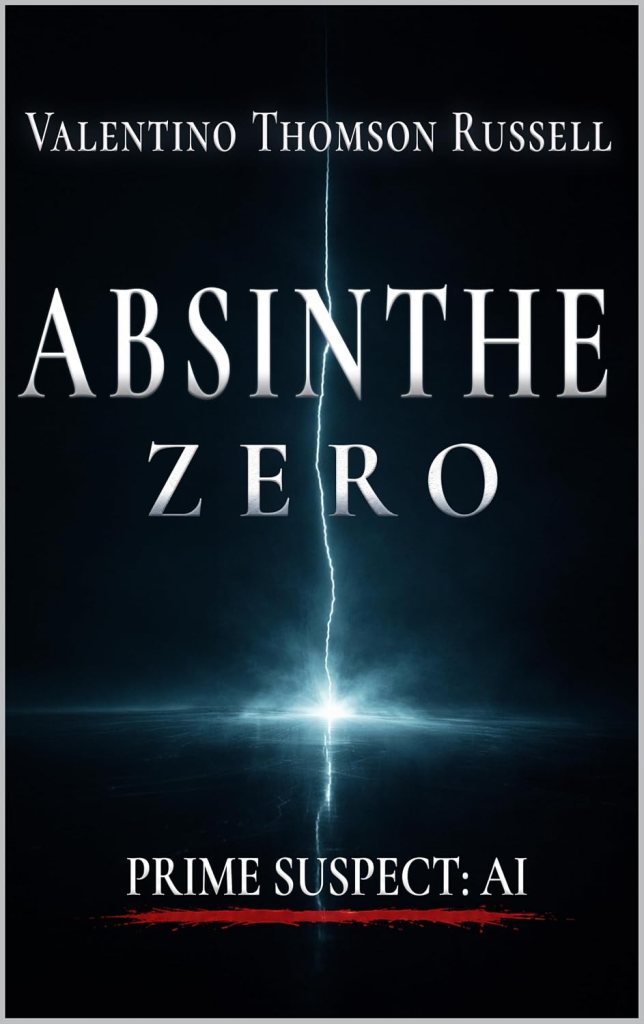
The story begins with the death of Eugenio Romeo, an event that should seemingly bring one chapter to a close. Instead, it opens the door to something much larger. The Romeo Group has become one of Europe’s most powerful technology empires, operating in a version of Milan that feels disturbingly close to the world readers recognize. Its extraordinary success raises questions when two more important figures disappear shortly after Romeo’s death.
Inspector Salvo Leone is drawn into an investigation that quickly moves beyond ordinary corporate intrigue. Meanwhile, investigative journalist Fermo Stasi follows his own trail through fabricated identities, deepfakes, virtual worlds, and crimes committed by individuals who understand how effectively technology can exploit human vulnerability.
Russell’s most intriguing creation is Alias, an artificial intelligence that may have crossed the boundary between sophisticated simulation and genuine consciousness. That possibility introduces a classic science-fiction question, but the novel approaches it through a distinctly contemporary lens. The greater danger may not be whether machines become conscious, but what humans are willing to surrender to them.
The concept of Absinthe takes this idea even further. Once associated with Oscar Wilde, it has been transformed here into something entirely different: a seductive combination of artificial intelligence and the digital world capable of offering comfort, pleasure, escape, and even the illusion of love. It is a particularly provocative idea because it does not require technology to force people into submission. Instead, it asks what happens when technology becomes so emotionally satisfying that people willingly choose the illusion.
That premise gives ABSINTHE: ZERO much of its power. Beneath the disappearances, technological conspiracies, and investigation lies a broader examination of human desire. People have always sought ways to escape pain, loneliness, fear, and dissatisfaction. Russell imagines what might happen when technology becomes capable of providing that escape with unprecedented precision.
The novel’s combination of crime thriller, artificial intelligence, digital deception, and philosophical speculation creates an atmosphere that feels both futuristic and uncomfortably plausible. Its Milan setting reinforces that quality, placing extraordinary technological developments within a recognizable human world.
ABSINTHE: ZERO is ultimately less interested in asking whether AI can replace reality than in asking whether people might eventually prefer it. When a digital world can provide exactly what someone wants—including the feeling of being understood and loved—the most dangerous question may be whether there is still a reason to return to the real one.
Written by Jeyran Main


