
Review Tales
Trusted Reviews and Author Features Since 2016
The Buried Symbol (The Runes of Issalia #1) by Jeffrey L. Kohanek (Book Review #86)

This review was kindly requested by the Author, Jeffrey L. Kohanek
This book is like a breath of fresh air! Brock is stuck in a world where an individual’s self-worth is categorized and classed based on runes. At the beginning of the story, the author welcomes you to a beautifully described world which Brock lives in. His aunt is on her death bed; they hardly have enough money to even provide medication for her. Brock is tired of being ignored and everyone around him seems to have accepted their fate. His dying aunt informs him about a guy named Alonza that can mark him as a member of the empires ruling class and create a fake tattoo for him. Brock takes this chance and changes his destiny.
The Empire trains leaders and Brock becomes a student at the academy. As he becomes accustomed to his new way of living, he discovers special powers and secrets that change everything for him.
I found Brock’s character written to be completely relatable and it was very easy to bond with him. The supporting cast also played a strong and much-needed part of the whole tale. This was necessary and done in a very well put together plot simply because there was a need for more depth in this tale.
The pace, action, drama, and twists were nicely presented at the appropriate times. There are references to drugs, some violence, and sexual content but not anything explicit to warn you from. The fantasy world is very intriguing and there is enough compelling content to make you not want to put the book down.
There are pleasantly drawn maps and pictures within the book that make it stand out and different than others in its same genre.
I recommend this book to anyone that likes science fiction and fantasy.
Written by Jeyran Main
Kings of This World by Peter Bailey (Book Review #333)


As it takes Matthew a few chapters to discover what is going on in the world, he meets Jeremy, who also happens to have kept his mind intact. They both seek reason and understand that it is all based on aliens taking over the land harvesting people to create a weapon.
I firstly wanted to congratulate the author on the novel approach to storytelling. I have read many books, but I have never read something like this before. The literature was easy to follow, and the story had a smooth paste to it. The subject matter did have some sensitive topics that may be disturbing for some to read but if you like thrilling horror style books, this would also suit your desire.
I am not a big fan of aliens and the notion of stories that revolve around them. However, the author’s innovative style of writing was enjoyable to read. I recommend this book to sci-fi readers.
Written by Jeyran Main
If you would like a book review click here
Shatterproof by Rianne Moss (Book Review #89)
Shatterproof is a beautiful book written about addiction and drug abuse. Natalie Meyer is young and suffering from, this dependence. This was not how she started, though. A series of heartfelt occurrences in her life begin to shake this young girls heart and mind causing her to fall in such a path.
Natalie has a history of sexual abuse and lacks any love or support from her family. Her father throws her out into the street. This vulnerable girl has nowhere to go but to meet another fellow addict named Scott. She moves in with him and Natalie’s situation turns from bad to worse.
We may have read many books that have references towards these sensitive topics, however; I found this book to be refreshing as the author takes on a different approach. Rianne Moss’s style of writing and literature standard is welcoming to the eye and touching to the heart.
Although the story mostly focuses on Natalie’s situation, there are other characters in the story which take part in this tale acting like bread crumbs guiding you to what eventually participates in the finale.
This book is a great read for people that suffer similar situations in life and sufferings. It has references to major psychological issues such as abuse, drugs, loss, love, neglect, and many more insightful things.
I look forward to reading more from this author and admire her in writing about relatable and genuine to world topics, which many do not wish to address let alone talk about.
Written by Jeyran Main
This review was kindly requested by the Author, Rianne Moss.
If you would like a book review click here
Universal Human Rights – A Comparative Research
We are delighted to announce the publication of Allameh M. T. Ja’fari’s book titled “Universal Human Rights – A Comparative Research.”


As you may already know, Muhammad Taqi Ja’fari is a well-known scholar. He has written 41 books in addition to his 15-volume interpretation of Rumi’s, Mathnavi, and a 27-volume translation and interpretation of the Nahj-ul-balaqah.
Mr. Ja’fari’s progress in his field was so spectacular that he was conferred with the greatest degree of jurisprudence by the age of 23. Mr. Ja’fari’s other major works contain his most important thoughts and ideas in the fields of anthropology, sociology, moral ethics, philosophy, and mysticism. This book is another one of Mr. Ja’fari’s masterpieces providing us an insightful comparative view on universal human rights with references to Islam and the west.
Mr. Ja’fari’s book titled “Universal Human Rights – A Comparative Research” is now available for purchase with global distribution access to 39,000 retailers and libraries and is available on all formats: Amazon, Kobo, Nook, iBooks Store, Barnes & Noble, Chapters, Waterstones and more.
You may purchase or read more about this book by clicking on the image.
Alternatively, you can visit all of Mr. Jafari’s books by clicking on his website
For any questions or enquiries please contact Jeyran Main on jeyranmain@gmail.com .
If you would like a book review click here
How Dare We! Write: A Multicultural Creative Writing Discourse by Sherry Quan Lee (Book Review #332)


As I continued reading this book, I felt lost and a little overwhelmed with the fact that I had no idea that this was even an issue. I have been reading and writing for years and it never even dawned on me that there was a race issue when it came to publishing. I always believed that books were either judged by their cover design or its sales, but never on the name of the author or its background. Surely, when it came to writing, it did not matter how you look, but how you write. Am I missing something here? I began to wonder, are these people who just struggled getting published? Alternatively, were they truly discriminated?
Either way, the work in hand was commendable and worth the purchase to read. The formatting, editing, and laid out work were written with perfection. It discusses literary myths, grammar issues, personal narratives, being rejected and more. Each section is written with the added emotional aspect of how the author, alone, was impacted and felt on their journey, becoming a writer. I felt that this added a personal touch to the book and it was nice to know more about them.
I recommend this book to people who wish to be informed and look for supplementary text in a creative writing workshop.
Written by Jeyran Main
If you would like a book review click here
Puzzle of Fate by A. Reza Kamarei, Ph.D. (Book Review #83)

This review is written for Online Book Club
“I rate this book 4 out of 4 stars.”
Puzzle of Fate is a book written analyzing fate from a scientific point of view. Many books are discussing this matter whether it is philosophically or through religion. Others have also attempted to discuss this through fiction. However, here, we experience a novel approach towards something much debated amongst scholars.
Is fate designed? Or can it be manifested? Are you able to create your own destiny? Who is really in charge?
I began reading this book with an open mind and open heart. I was expecting something new or innovative in the world of debate. What I found surprising was that this Author manages to use old methods in pinpointing, elaborating and classifying factors and sub-factors that contribute to the building and shaping of our fate. Therefore, he has created an innovative way of debating using already used factors! Now that is a treasure indeed.
Dr. Samarei invites us to use a drawn, six-factor system in a schematic diagram, calling it the House of Fate and indulges us stating that each factor will impact our lives at different times and forms, shapes and directions. They all affect us in various ways and what was more pleasant is that he declares:
“The past does not have to be your prison. You have a voice in your destiny. You have a say in your life. You have a choice in the path you take.”
The happiness and quality of life you lead is also mentioned in this book. Another intriguing part of the book was the “Unique Summit.” It is a term used when you have reached everything you have desired in your life. It is a destination where you will be satisfied and what more could any person need or want out of life?
I found this book to be compelling and a bit of fresh air in the science world. Readers that desire to know the truth about the logistics of fate and how to achieve an ultimately satisfying life will enjoy this book.
I highly recommend this book to everyone.
Written by Jeyran Main
If you would like a book review click here
The Compulsive Move by Philip Cornell (Book Review #82)

This review is written for Online Book Club
“I rate this book 2 out of 4 stars.”
The Compulsive Move is a book written about a boy named Kevin. From the beginning of the book, I noticed something different. The way the story is told is through a third person but in a very weird way. The third person speaks about the story using terms like “Do you know what I mean?”, “As you can see” or “Don’t get me wrong.” The book claims to be a fiction. However, it is not written like one. I did not like the literature and strategy used in telling the story.
Kevin is a confused teenager trying to figure out what he wants in life and what path he should take. His family is normal, and nothing is alarming or confusing about them causing Kevin to behave abnormally. He has friends and even has a love interest, J’Adore.
This ten-chapter book covers his journey to Chicago only because he is accepted into university. His money runs out, so he starts dealing drugs and smoking marijuana to make ends meet. He is in the wrong crowd giving him the wrong guidance. A robbery shakes Kevin to his core diverting him back to doing the right thing and working for his money.
I found the story to be very basic. There are no twists or big reveals. It does not even discuss real issues teenagers face. Even when he is dealing with drugs or smoking, I was expecting more emotions, turmoil, questions and doubts, possible anger or resentment or just something related to what teenagers face these days. There are references in making fun of people that are a transvestite, which was uncalled for. The book also contains too many grammatical, sentence structure and other issues that need a professional editor to fix.
There was no significant execution of the difficult tasks a teenager faces. However, it does, cover issues where teens face entering university, funding, and living alone away from their families. The author does also reference how hard it is living in a job where you really do not see any self-worth.
I will end this review wishing the author all the best in his next work.
Written by Jeyran Main
If you would like a book review click here
Surviving Schizophrenia by Richard Carlson (Book Review #331)
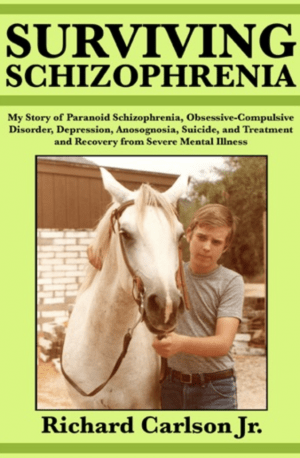


Unfortunately for Richard, he never was diagnosed correctly and subsequently, lost a lot of his precious life going through turmoil. He kept hearing voices; he suffered from depression, anxiety, lack of motivation, and the inability to identify what was real and what was unreal.
Although this topic and the nature of the work is sensitive, many have now recognized it as a serious issue. Discussing schizophrenia is no longer a taboo and thankfully, books like this one, keep the subject matter alive.
I believe the author’s intention is to create awareness and to prevent his experience from happening to someone else.
The writing and literature standard is easy to understand and to follow. There is a nice flow between the chapters and paragraphs. I believe when these topics are being talked about, an easy to comprehend approach is always more successful, and that is that case with this book.
I recommend this book for people who enjoy psychology and are especially interested in the study of Schizophrenia.
This review was requested by the author and Underrated.com
Written by Jeyran Main
If you would like a book review click here
Netwalking Space by Joyce Reynolds-Ward (Book Review #88)
 Aliens have attacked Earth before using a Gizmo war machine that destroyed many cities on Earth. Bess and her family managed to confine this machine and stop the destruction. The machine endorsed Bess and her family to create a Netwalk. This Netwalking Space became a communication system that allows personalities to upload when they die. Bess’s grandmother, great-grandmother, and mother have all passed on into this Netwalk.
When Bess and her family realize that the aliens are planning to attack again, they have to work together to defend Earth. However, friction takes over this family. Sarah, Bess’s great-grandmother, has a past that is revealed causing Diana, Bess’s grandmother to have a meltdown and join the Gizmo collaborators.
There is an added romance between the lead character and a certain accompanied gentlemen that blossoms within the right amount of time built into the story which I found to be an additional bonus.
Many words can easily describe this wonderful book. However, none can do it justice. The plot is original, and it is a family-oriented story, which is very touching. All the characters and casting crew have enough written backstory and relatable personalities. It was effortless to feel and bond with each and every one of them.
The pace and settings of the story were fantastic. Every page is interesting and not filled with fluffy content just to get by. Joyce Ward has definitely presented one of her greatest works. The literature standard was so easy to understand yet contained enough science fiction and space terminology to keep the intelligent mind intrigued.
The love and bond for protecting a family member regardless of them passed on or alive was admirable. Our daunting pasts can always get to us, but family always comes first.I recommend this book to readers that like science fiction and space stories.
I recommend this book to readers that like science fiction and space stories.
Written by Jeyran Main
This review was kindly requested by the Author, Joyce Reynolds-Ward.
If you would like a book review click here


